
DOMAIN 2Governance and Leadership
Standard 5 - An excellent Catholic school has a governing body (person or persons) which recognizes and respects the role(s) of the appropriate and legitimate authorities, and exercises responsible decision making (authoritative, consultative, advisory) in collaboration with the leadership team for development and oversight of the school’s fidelity to mission, academic excellence, and operational vitality.
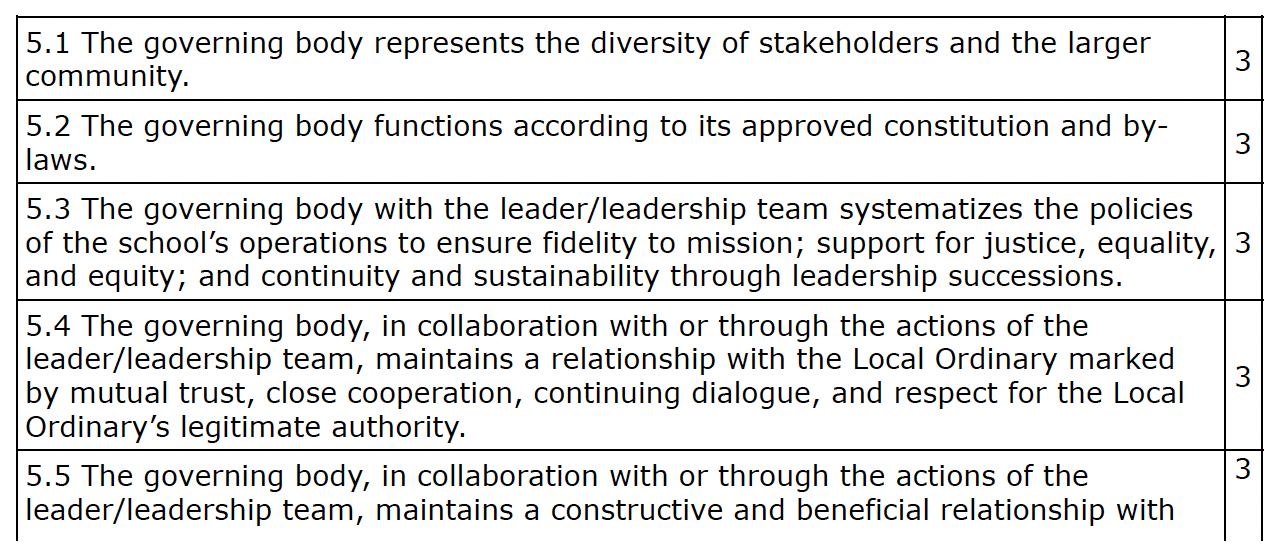
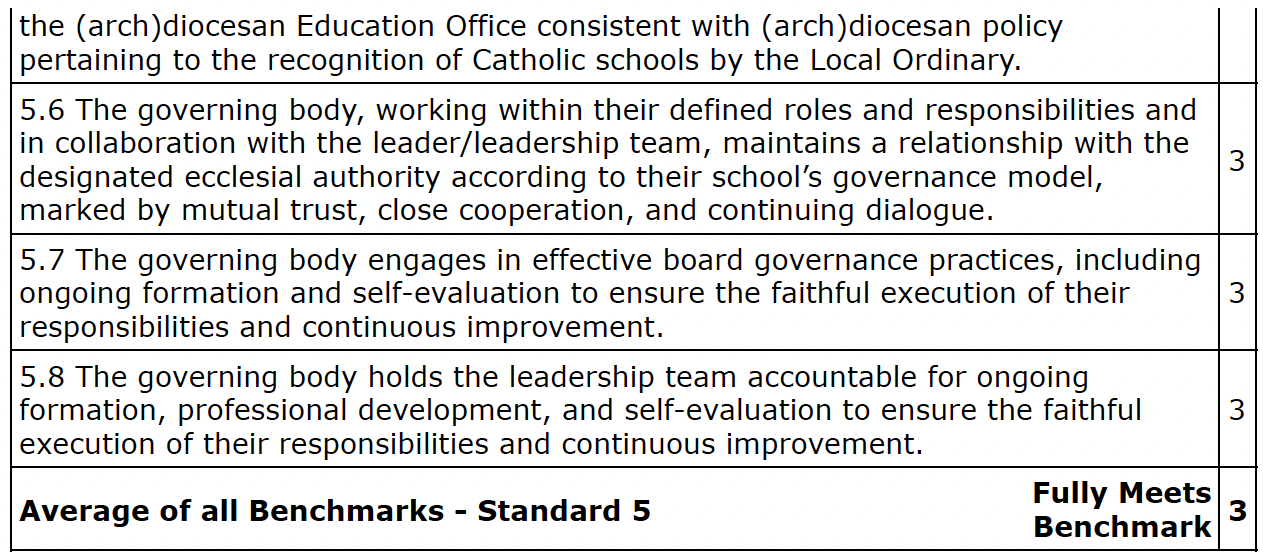
St. Bonaventure School demonstrates a well-structured and collaborative governance model that upholds its Catholic mission through strong leadership, transparency, and shared decisionmaking. The governing structure, which includes the Parent-Faculty Association (PFA), Leadership Team, and School Board, works collectively to provide oversight, direction, and representation for the school community. This collaborative framework, supported by clearly articulated operational policies and documented through minutes of the PFA, School Board, Leadership Team, and Parish Finance Council, ensures continuity, accountability, and alignment with the school’s mission. The governing body and leadership team maintain a trusting and cooperative relationship with the pastor, marked by ongoing communication and respect for his ecclesial authority, while also maintaining compliance and alignment with diocesan policies through regular engagement with the Diocese of Orange Education Office. Evidence of this partnership includes participation in diocesan meetings, adherence to Catholic school recognition requirements, and consistent professional development.
Leadership accountability and growth are further reinforced through ongoing training, professional development, and regular meetings among administrators. The school’s leadership fosters collaboration internally and externally by engaging teacher representatives, maintaining open communication channels, and using stakeholder feedback to inform decision-making. While governance practices are strong and effective, opportunities remain to enhance impact through formalized self-evaluation tools, expanded leadership collaboration, and data-driven alignment of professional development goals. Overall, St. Bonaventure School’s governance and leadership demonstrate faithful stewardship, strategic collaboration, and a sustained commitment to the mission of Catholic education.
Standard 5: Narrative Rationale
-
The governing body demonstrates effective governance through consistent communication and clear accountability structures. Regular participation in diocesan meetings, the use of survey data to guide improvement, and ongoing dialogue among the pastor, principal, assistant principal, leadership, and faculty representative ensure that decision-making is collaborative, transparent, and well-informed.
The governing body promotes leadership accountability by emphasizing ongoing training, professional development, and self-assessment. Weekly meetings between the assistant principal and the principal, Tuesday meetings with the administrative team, and a calendar of professional development events attended by both the principal and assistant principal all contribute to continuous improvement and effective fulfillment of responsibilities.
-
Ongoing representation from the broader community should be ensured across all governing bodies, with renewal occurring annually or at the end of each term.
For greater financial clarity and governance, the school should consider creating a school financial board distinct from the parish financial council.
Key Strengths & Growth Areas
Data Library Evidence
School Survey Evidence
Standards of Excellence School Vitality Survey: Parent/ Community and Faculty/Staff - Click HERE
Standards of Excellence School Vitality Survey: Students - Click HERE
Standard 6 - An excellent Catholic school has a qualified leader/leadership team empowered by the governing body to realize and implement the school’s mission and vision.
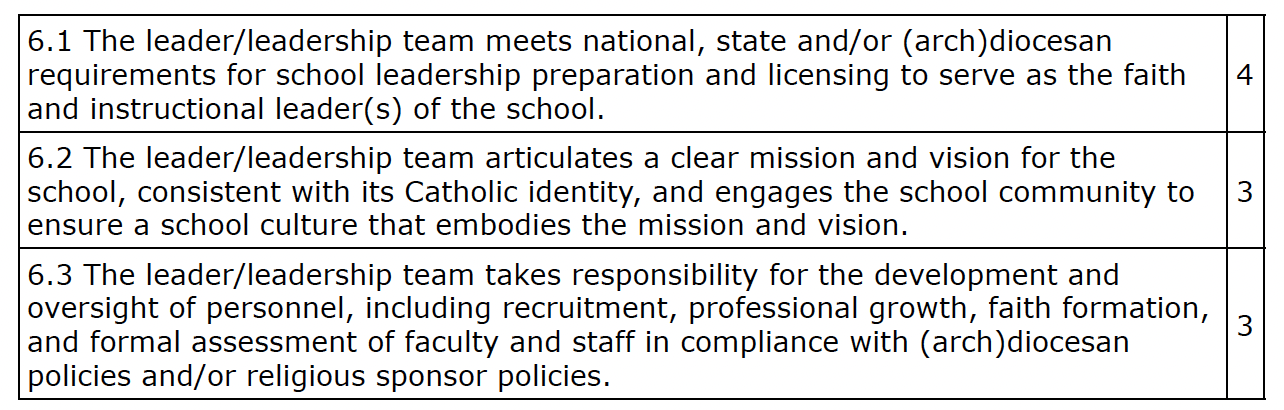
St. Bonaventure School demonstrates a strong commitment to its Catholic mission through intentional faith formation, qualified faculty, and visible expressions of Catholic identity. The school community begins each day with morning prayer led by the Principal or Pastor, students participate in weekly Mass, and the mission statement is consistently highlighted in school communications. Beginning in the 2025–2026 school year, the Hallow app will further support faith formation for students, staff, and families. Faculty and staff are supported in ongoing spiritual and professional development through funded workshops, retreats, and learning opportunities.
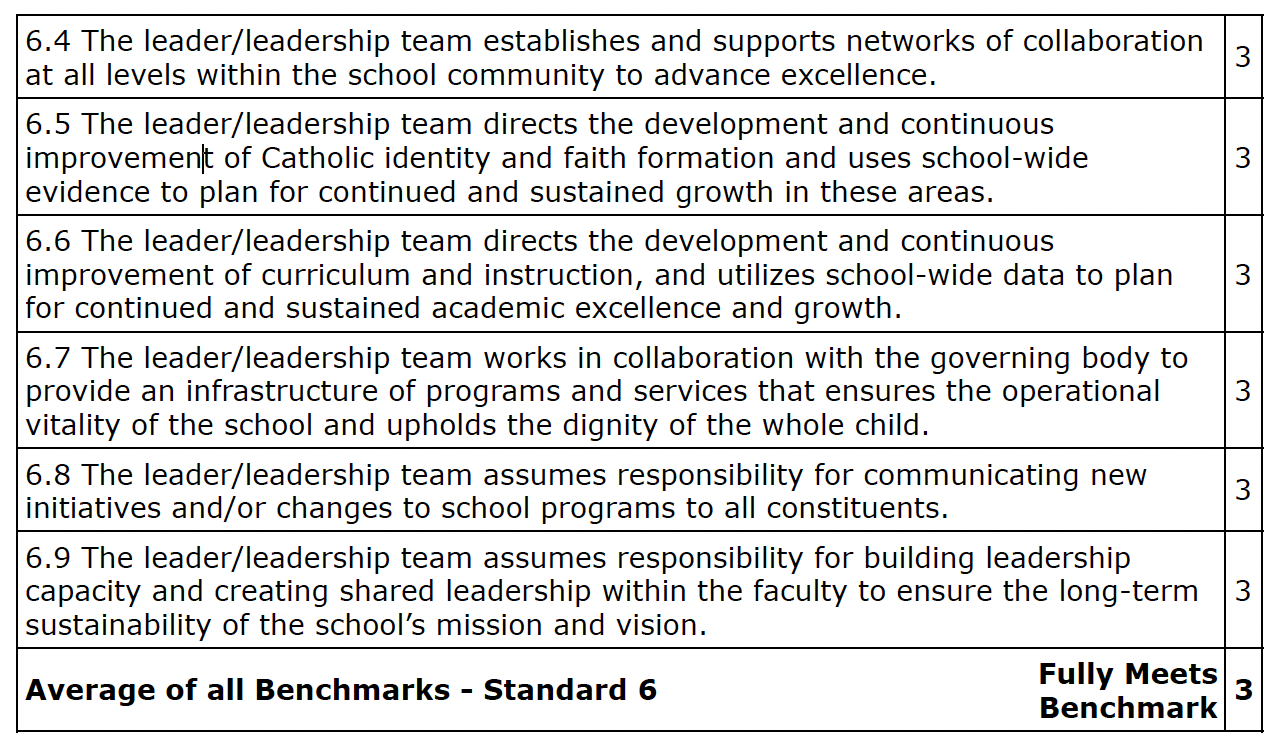
The administration team fosters collaboration and professional growth through PLCs, faculty and aide meetings, Student Council, parent groups, and school committees. Curriculum maps and standards guide instruction, weekly lesson plans provide structure, and primary teachers share learning goals with families. Supplemental programs like Freckle support differentiated learning. Catholic identity is woven into daily life through prayer tables, crucifixes, Faith Families, and recognition programs such as monthly awards and scholarships. While collaboration and Catholic identity are strong, the school continues to develop the systematic use of school-wide data to guide decision-making, contributing to multiple “meets benchmark” ratings.
Operational vitality is supported through the partnership of the leadership team, the governing body, the Advancement Office, and the Business Manager. The school counselor now serves students five days a week, and recent campus improvements, including LED lighting, interior paint, and planned bathroom remodels, enhance the learning environment. Communication with constituents remains consistent and accessible through newsletters, social media, the school website, printed materials, and direct access to leadership. Together, these systems reflect a mission-aligned, forward-focused approach that sustains the school’s vision and supports the well-being and success of every student.
Standard 6 Narrative Rationale
-
Each member of the administrative team actively engages in ongoing professional development, both within their specific areas of expertise and across diverse disciplines, to strengthen and enhance the school and its broader community.
SBS demonstrates a strong culture of collaboration that extends well beyond faculty. Leadership intentionally supports structures for teachers (PLCs, staff and aide meetings), students (Student Council, extended day), parents (PFA, room moms, mom’s prayer group), and governance (School Board). The variety of groups shows that collaboration is not isolated to academics but is woven into instructional planning, faith formation, extracurriculars, and parent partnerships. This breadth of involvement highlights the school’s commitment to engaging all stakeholders in advancing excellence.
-
Expand opportunities for professional development and support structures for faculty and staff to maintain continuity.
Develop intentional structures, including focused subcommittees and transparent budget and collaboration processes, to amplify faculty voice, encourage shared leadership, and foster broader participation in advancing the school’s mission and strategic priorities.
Key Strengths & Growth Areas
Data Library Evidence
School Survey Evidence
Standards of Excellence School Vitality Survey: Parent/ Community and Faculty/Staff - Click HERE
Standards of Excellence School Vitality Survey: Students - Click HERE
Summary of Domain 2
St. Bonaventure School demonstrates a well-defined, collaborative governance and leadership structure that supports its mission, continuity, and sustainability. Governance is shared among the Parent-Faculty Association (PFA), the School Board, the leadership team, and parish leadership, providing oversight, representation, and shared responsibility for decision-making. Clearly articulated policies, constitutions, and bylaws guide school operations and ensure fidelity to mission, justice, equity, and long-term planning. Documentation such as meeting minutes and agendas confirms that current, former, and future leaders can carry forward the school’s mission through established systems and transparent practices. The governing body and leadership maintain strong, respectful relationships with the Pastor and the Diocese of Orange, marked by regular communication, collaboration, and adherence to diocesan policies and expectations.
Leadership at St. Bonaventure School fosters a positive, mission-driven culture through structured collaboration, clear communication, and strategic planning. Faculty and staff are supported in ongoing professional and spiritual growth, and collaboration is encouraged through PLCs, faculty meetings, committees, and parent groups. The leadership team directs Catholic identity, curriculum, instruction, and operational improvement while ensuring visible expressions of faith and a nurturing school environment. Systems for communication, planning, and transparency are well established, contributing to organizational clarity and trust. While governance and leadership practices consistently meet accreditation benchmarks and reflect effective implementation, the school recognizes opportunities for continued growth, particularly in systematically monitoring leadership development and using schoolwide data more intentionally to guide ongoing improvement.